Tag: retirement

  • Namibia Days 11 – 14 Damaraland

    Namibia Days 11 – 14 Damaraland

    Today’s 330km drive took us to Damaraland. We broke the 5 hour drive with a stop en route at the Coffee and Cactus tea rooms in Uis, where we had been advised the apple pie was better than McGregor’s Bakery.  Happy to test the challenge, the half-way stop was a welcome break, but sadly they had no apple pie so unable to report back on this occassion, but we had a piece of cake and a milkshake which were both delicious.
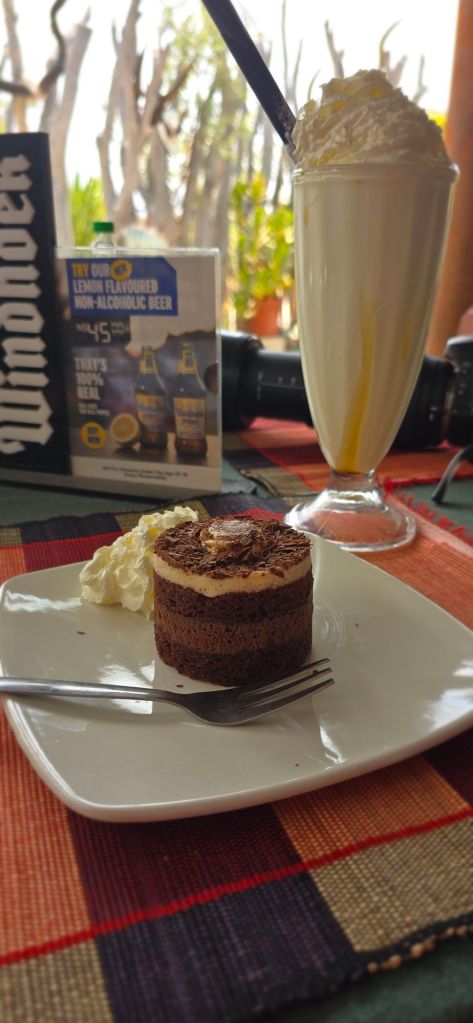
    Not apple pie!!
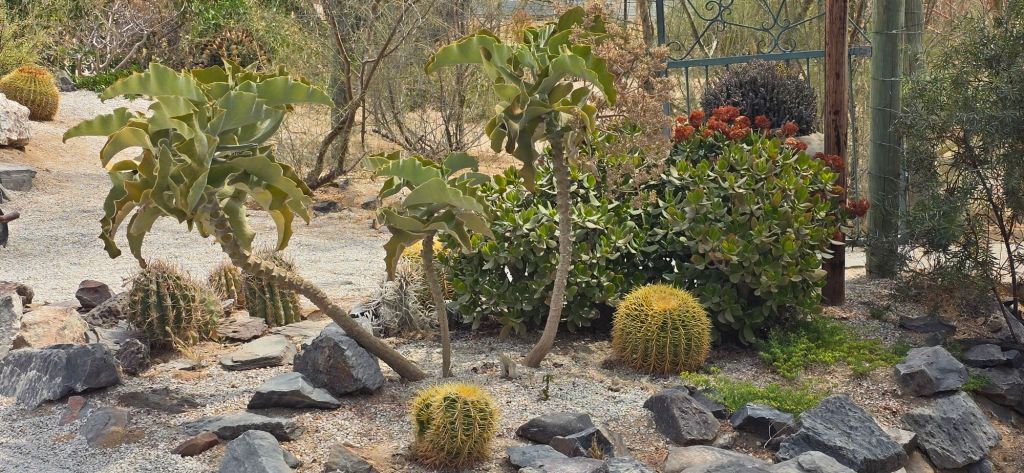
    Coffee and Cactus
    tea room gardens

    Desert-adapted Elephants

    Damaraland is famed for its herds of desert-adapted elephants, and since elephants are my favourite African animal, a trip to this region was a ‘must-do’ part of our itinerary.  These elephants have adapted to survive the harsh dry conditions of the desert regions.  They have longer legs, larger feet, and a smaller body mass than their cousins, which allows them to last several days without water.  There are only around 1,000 of them in existence so to spend a few hours following a couple of families, as they wandered along the dried Huab River valley was a highlight of our trip and an absolute privilege.
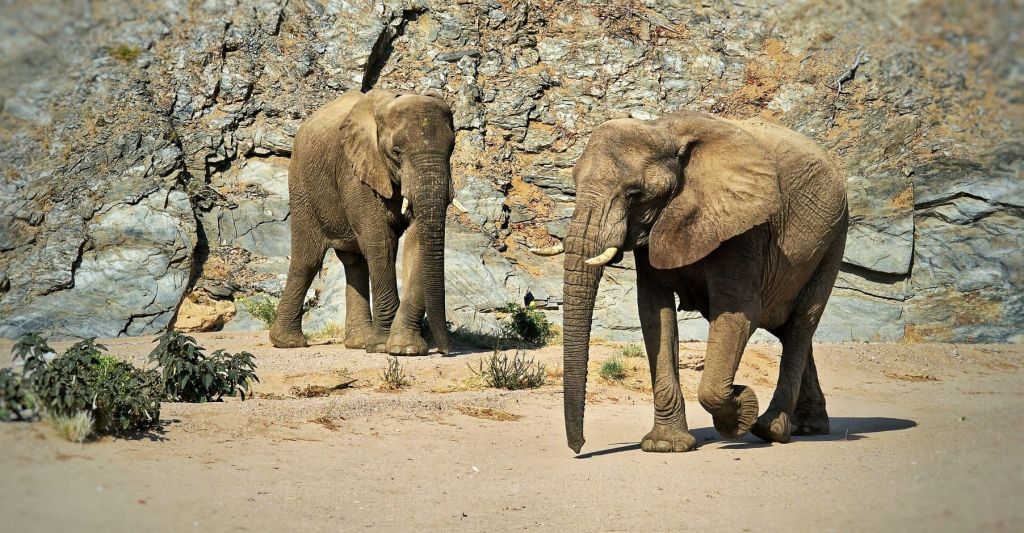
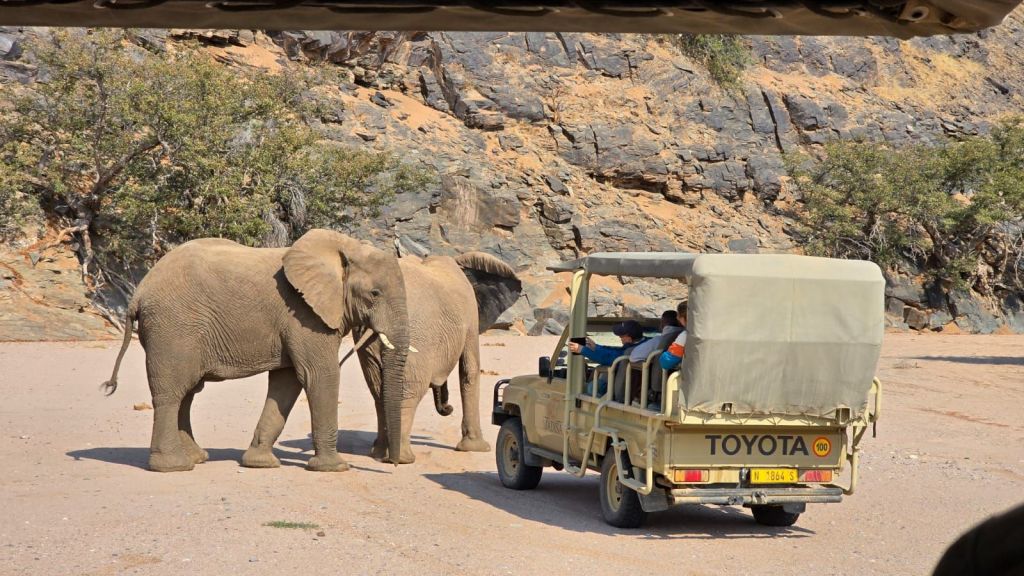
    Desert-adapted elephants

    Organ Pipes

    The area is also known for its various rock formations, so we took a drive out to a couple of sites close to our lodge. 

    We drove by the Burnt Mountain – a 12km long volcanic ridge with an 80million year old solid lava flow at its base.  The changes in colour as the sun caught the lava were pretty spectacular and no pictures could do it justice.

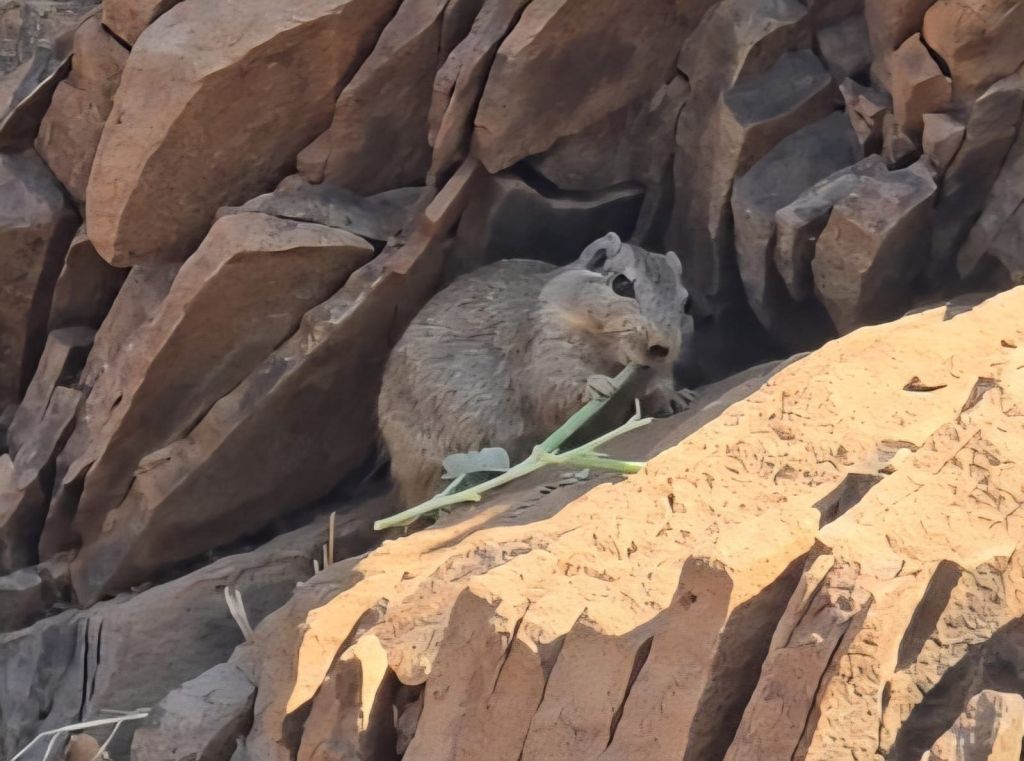
    Next visit was the ‘Organ Pipes’ – a small gorge with 100m stretch of basalt rock formations resembling organ pipes (if you squint a bit!).  A bit pricey to visit with no guide, but it filled some time, and we spotted a dassie rat along the way.
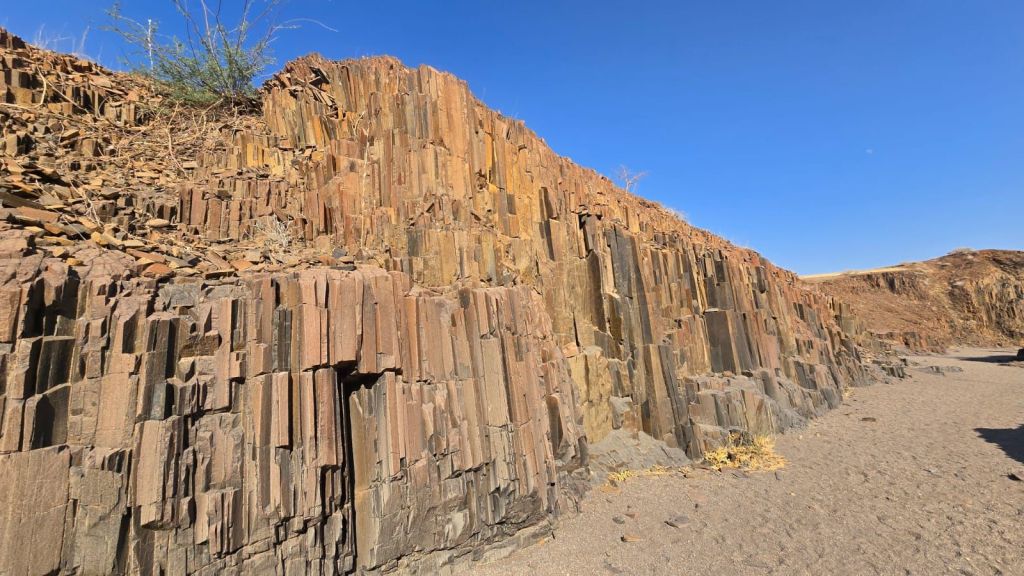
    Squint to see the organ pipes
    Dassie rat enjoying the shade

    Petrified Forest

    Another area of interest in Damaraland was the Petrified Forest – an area with 50ish tree trunks thought to be 260 million years old, deposited by an ice age flood.  The trunks are not standing, and were only discovered by local farmers in the 1940’s as a result of the shifting sands.  The area has been declared a national monument and whilst geological studies have taken place no formal excavation of the site has been allowed, so the exposed elements are all natural.
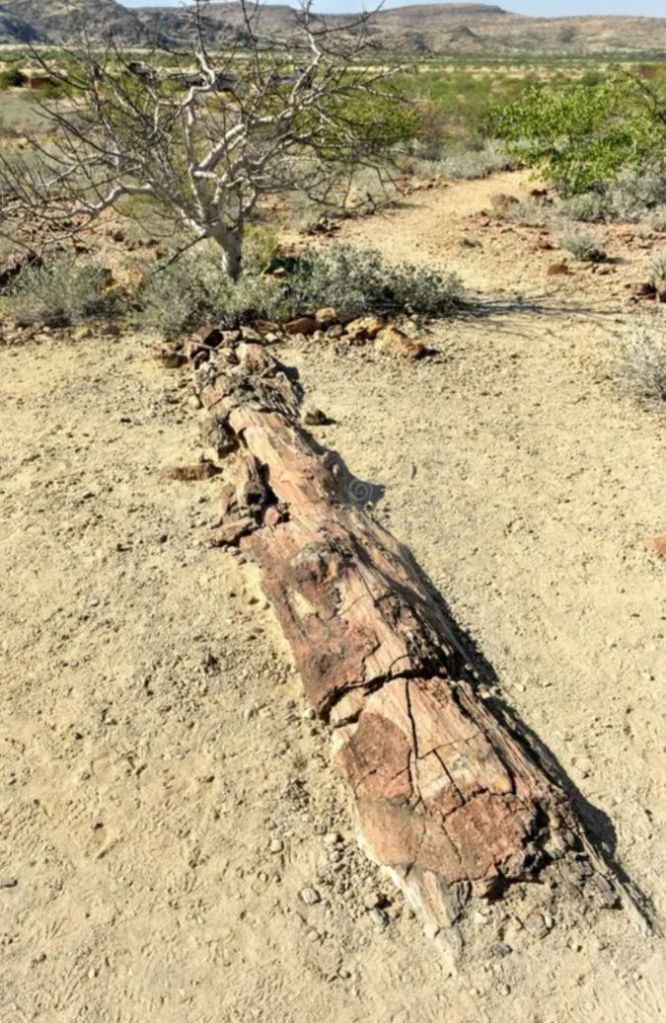
    Petrified forest tree trunk

    Welwitschia

    Whilst visiting the Petrified foredt, we were introduced the National plant of Namibia.

    At first glance, this rather ugly plant is a bit uninspiring, but its relevance as a national emblem tells another story.  The plant consists of just two leaves, and can live for thousands of years, making it one of the longest living plants on the earth, with the leaves splitting, protecting the plant from wind erosion, as they continue to grow in the extreme conditions of the Namib desert.  So its story of resilience and endurance through adversity mirrors the story of Namibia and its people.
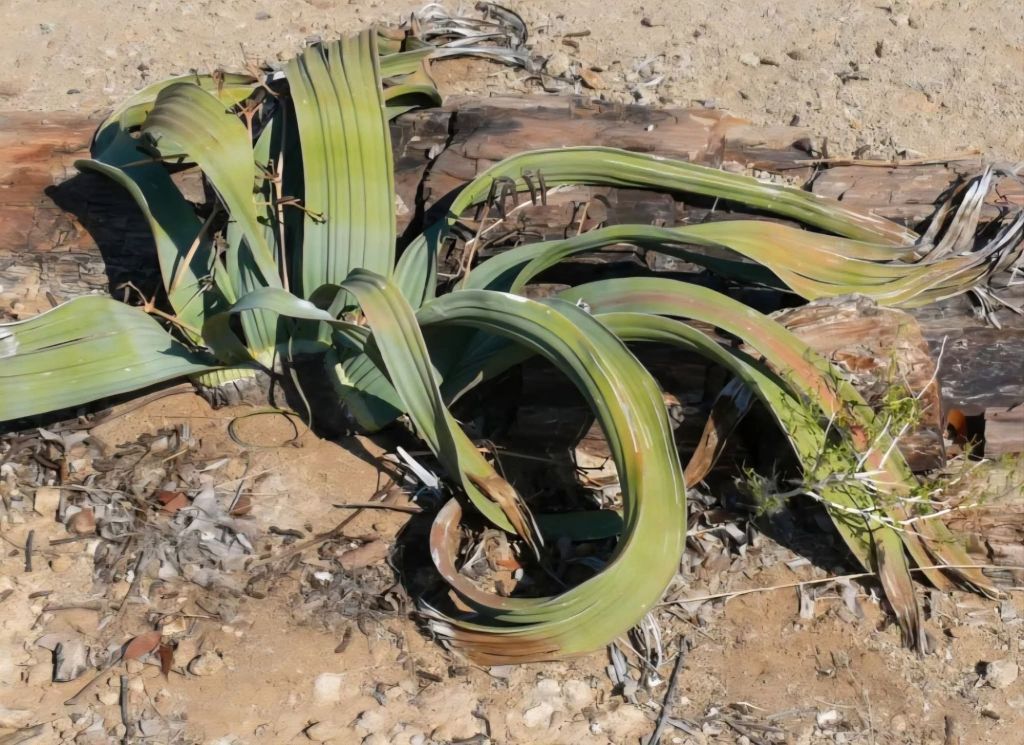
    Welwitschia – the national plant of Namibia

    Twyfelfontain Adventure Camp

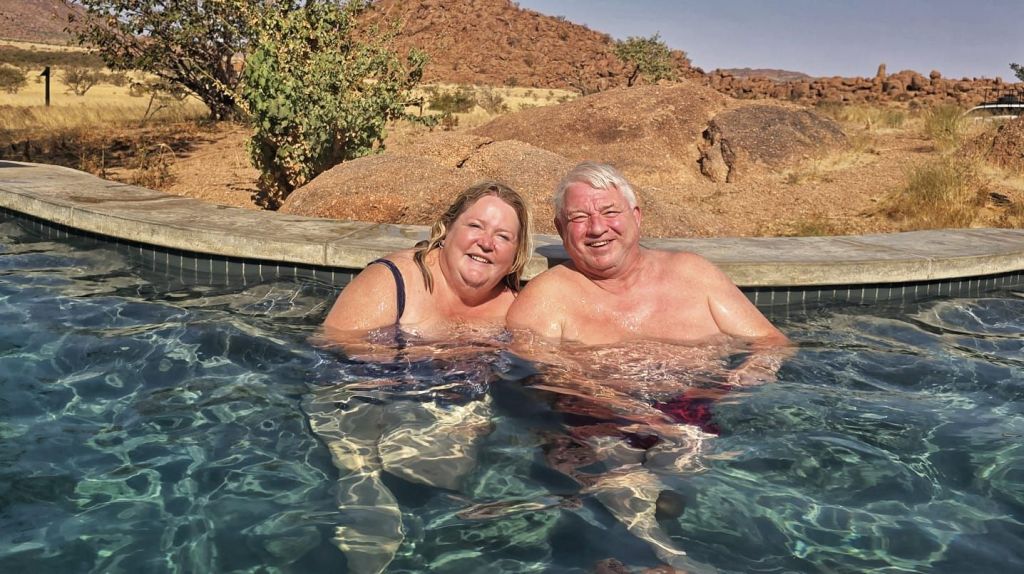
    We stayed 3 nights in a premium tent at Twfelfontein Adventure Camp, in the middle of the arid Damaraland, and the accommodation was fantastic,  a lovely refreshing pool and good choices of food, including daily barbecued options.

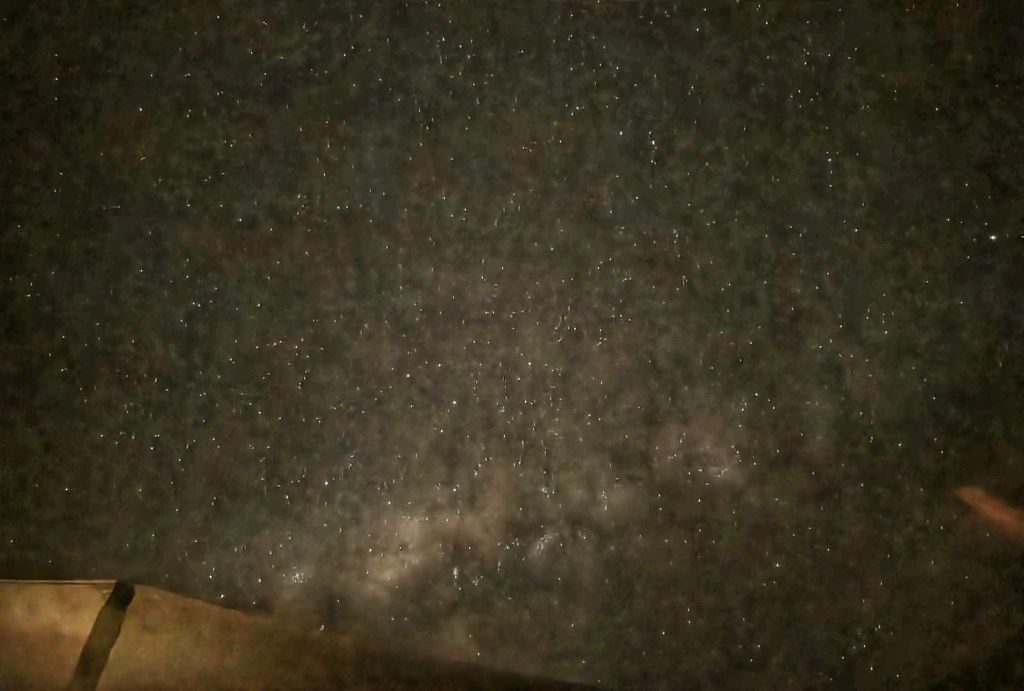
    What made this place ectra special were the dark night skies – we spent several hours watching shooting stars and attempting to photograph the milky way.
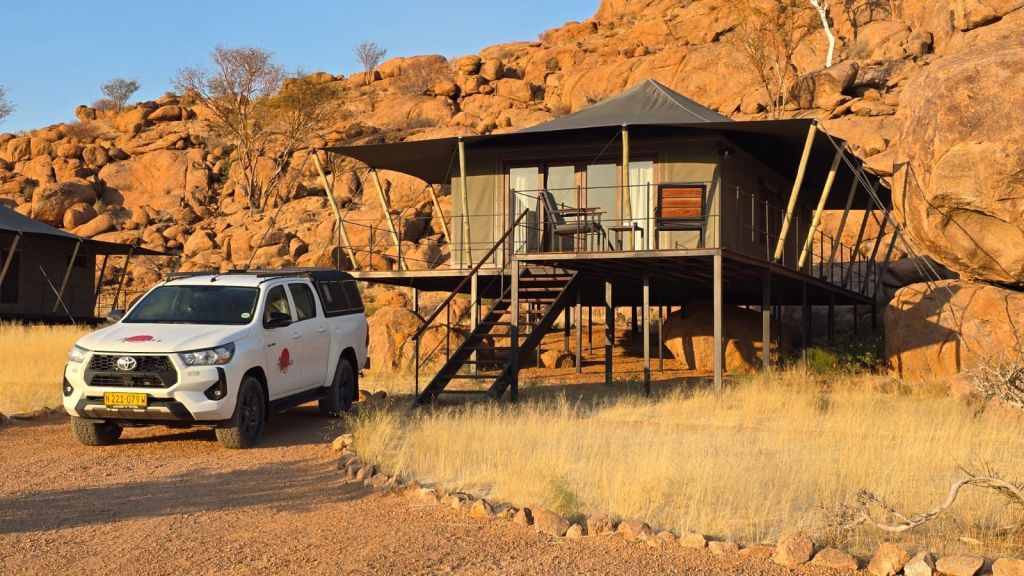
    Our lodge
    The refreshing pool
    The milky way
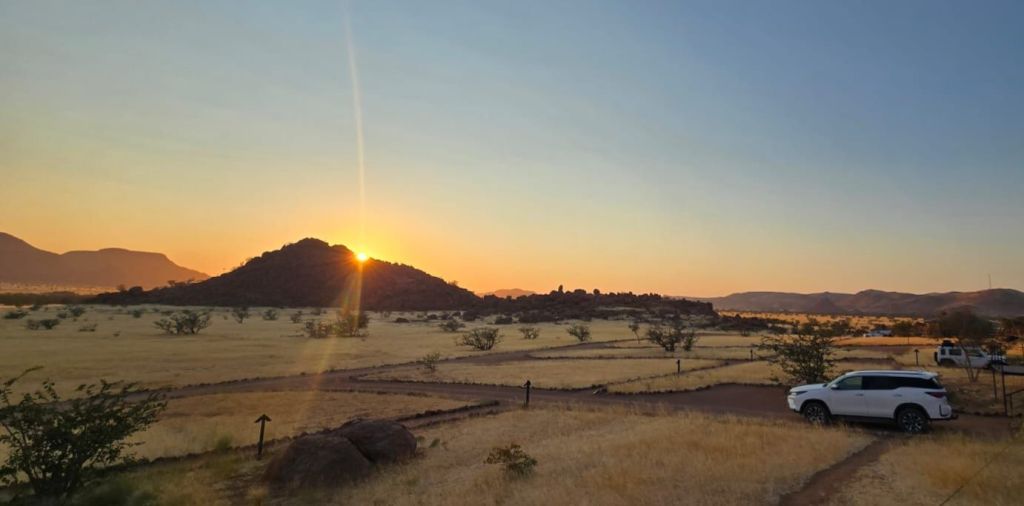
    Sunrise from the lodge
  • Namibia Days 8-10 Swakopmund

    Namibia Days 8-10 Swakopmund

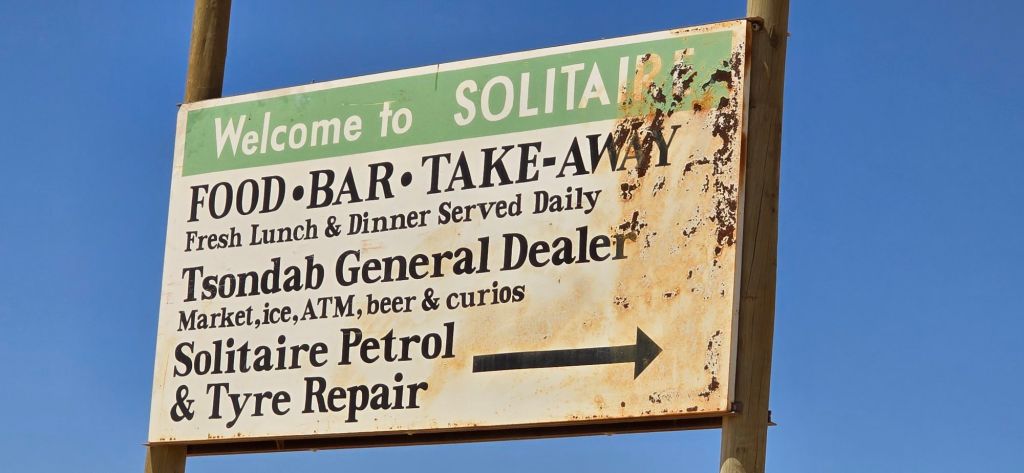
    Solitaire

    Solitaire Roadhouse

    Another long drive along gravel roads took us to our next stop – the coastal town of Swakopmund.  This road, nonetheless, has a couple of must-see tourist spots, so the journey didn’t feel quite so monotonous.

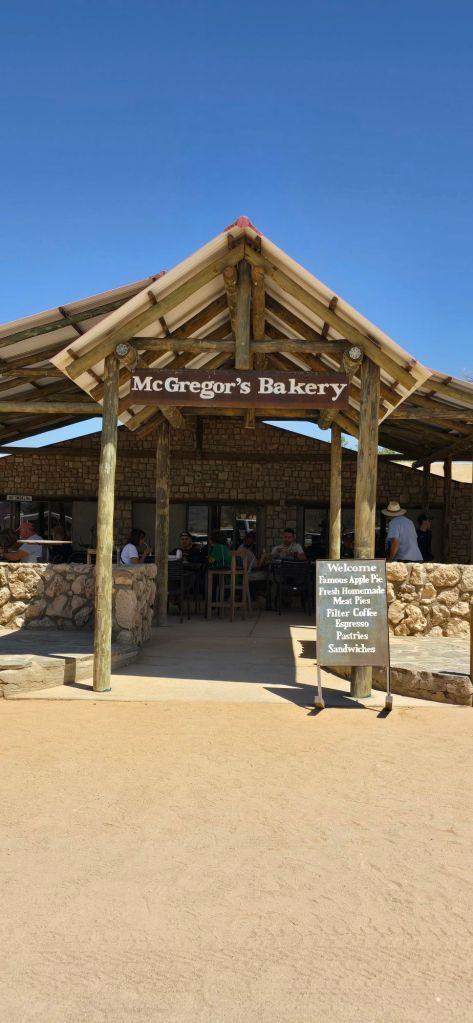
    The first stop is the Solitaire Roadhouse. Famous for its apple pie (or some say apple crumble), we had to give it a try.

    McGregor’s Bakery at Solitaire Roadhouse

    Is it a pie or a crumble?  In my opinion, it is somewhere in between.  A sweet biscuit crust base gives it a “pie” label. The “crumble topping” is more of a crumbled sweet crust, forming a more solid topping than the crumbs we are used to in the UK. 

    Whatever you call it, with plenty of apple filling, a hint of cinnamon, and most definitely not a mean helping, it did not disappoint.  We had ours served warm and plain – though ice cream was available. We also had a couple of slices of blueberry tart to take away.

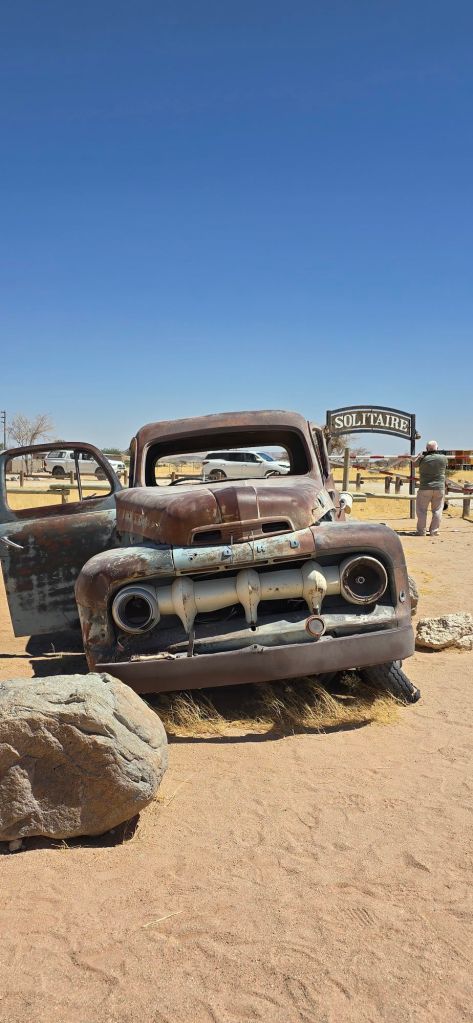
    In addition to the bakery, the roadhouse had a small shop, a collection of abandoned vehicles and, rather randomly, a small church!

    Abandoned car at Soliatire Roadhouse

    Tropic of Capricorn

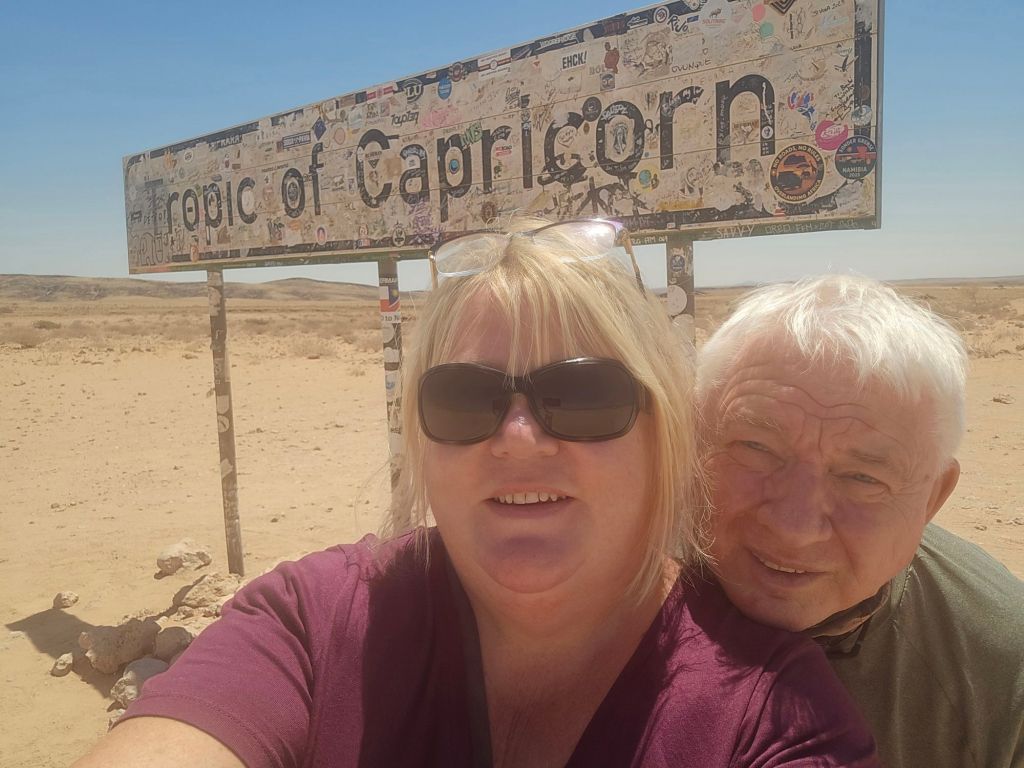
    Next stop on this leg was passing the Tropic of Capricorn.

    Us at the Tropic of Capricorn sign

    The Tropic of Capricorn is the circle of latitude that contains the sub-solar points at the December solstice. This means it includes the points on the earth where the sun is directly overhead at noon on 21st December.

    We arrived at our lodgings just in time for a quick shower before heading out to dinner.

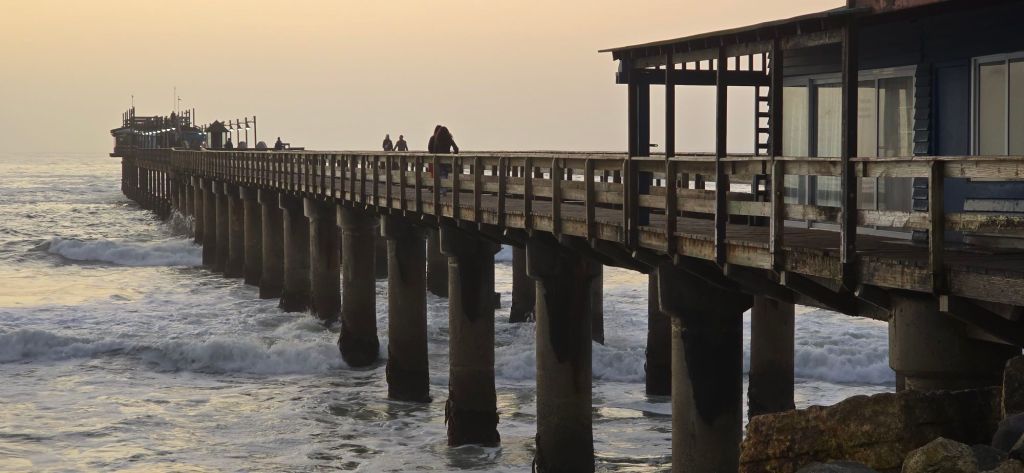
    Swakopmund Jetty

    Jetty 1905 is a popular restaurant situated on the end of Swakopmund jetty, and its prime location ensures its popularity with locals and tourists alike.  But, location aside, we were left underwhelmed.  Yes, we were tired from the journey and cold (yes, cold!), but the staff were inattentive and the place just lacked atmosphere.

    Walvis Bay

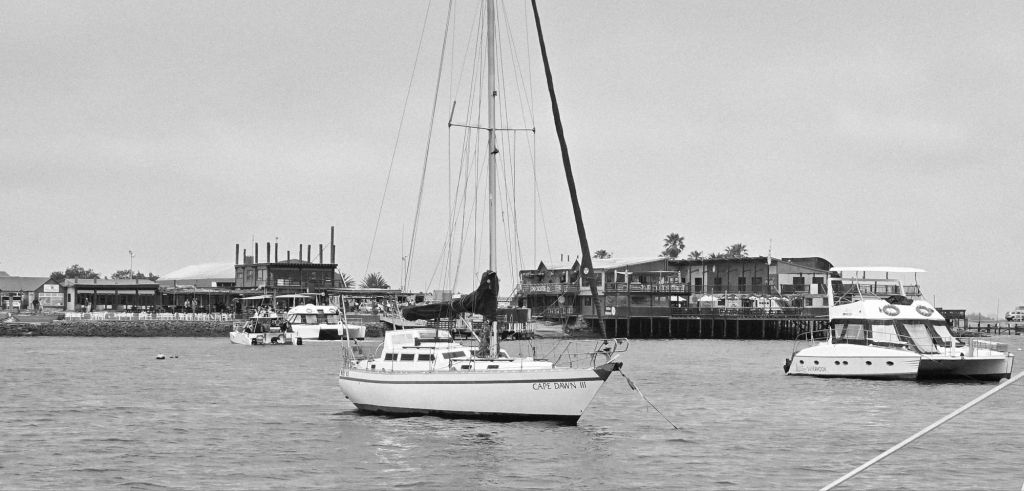
    Walvis Bay Harbour

    A short drive from Swakopmund, Walvis Bay (Afrikaans for “Whale Bay” due to the presence of the Southern Right Whales) is a natural harbour which is Namibia’s second city and main seaport.

    Home to an abundance of marine wildlife and a major stopover for migrating birds, Walvis Bay is a mecca for birdwatchers and wildlife enthusiasts alike. More recently, it has also become a centre for adventure tourism with 4×4 and dune buggy tours aplenty.

    Catamaran Cruise

    Our visit to Swakopmund saw us take a full day trip from Walvis Bay – a rather chilly catamaran trip in the morning, followed by a 4×4 drive through the dunes of Sandwich Harbour in the afternoon.

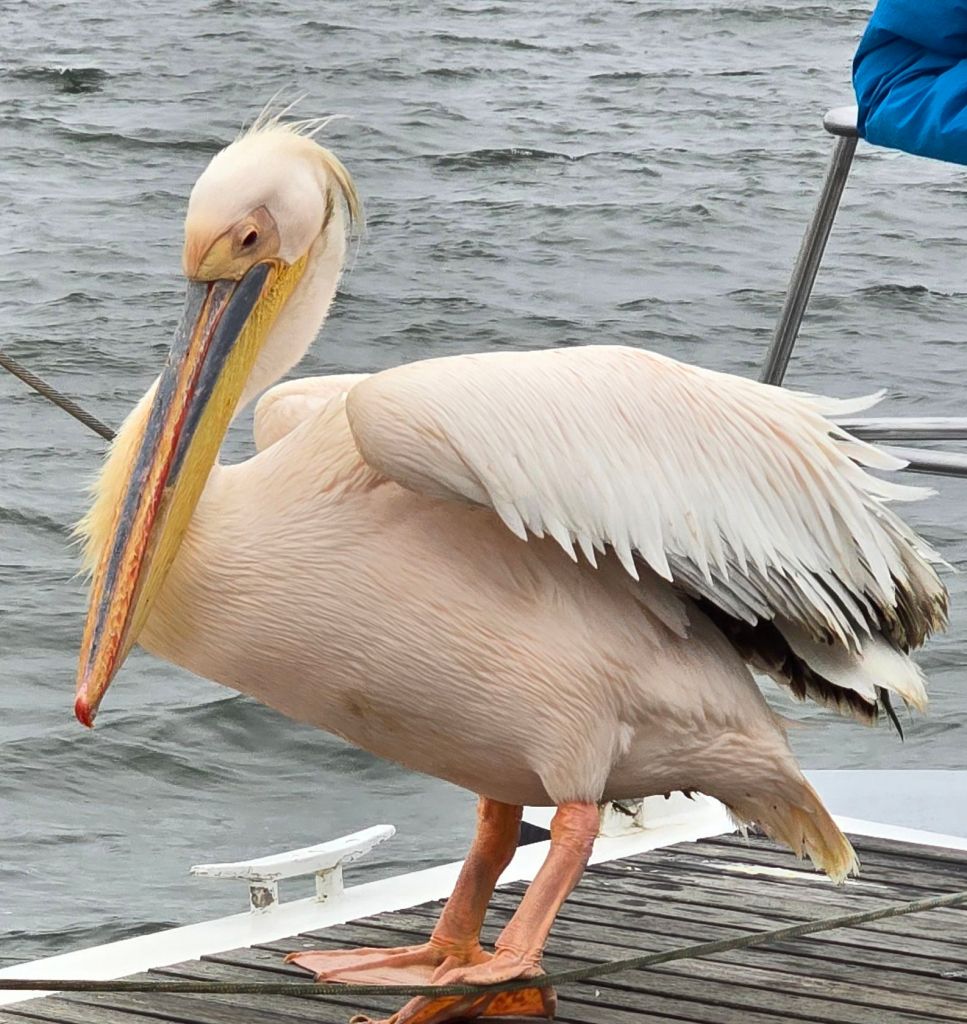
    Pelican visiting us on board the catamaran

    First thing to say is that it was cold!!!! 

    After the seering heat of the Sossusvlei desert, we certainly felt the chill in the air whilst on land, and even 4 layers of clothing didn’t make the air any warmer out at sea.

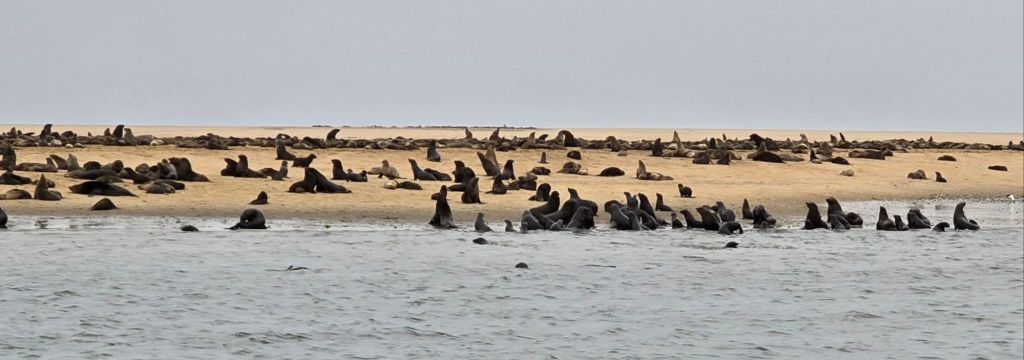
    Cape Fur Seal colony at Pelican Point

    Our spirits were not dampened though, as we were visited by a friendly pelican and a display from several humpbacked whales, as we made our way to see the cape fur seal colonies on Pelican Point. (The rather large dashes of Old Brown sherry helped keep us warm too). 

    A spot of light lunch with local oysters completed an enjoyable morning.

    Sandwich Harbour

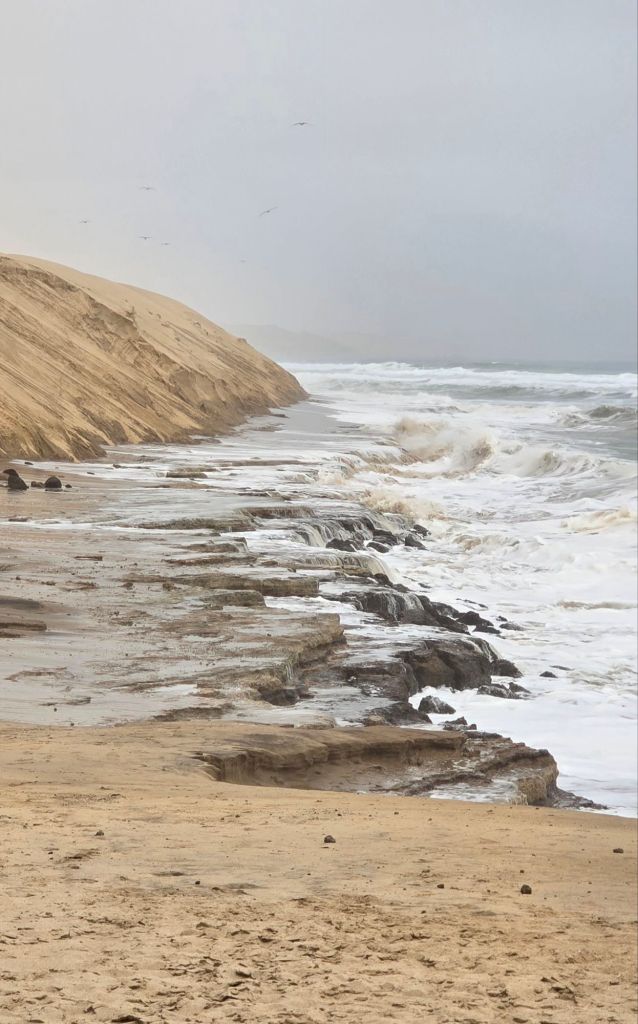
    Back on land and into a land cruiser for a 4×4 trip to Sandwich Harbour, where the desert dunes meet the sea. 

    The area can only be accessed by permit holders and the trip usually involves a drive along the beach to appreciate the height of the dunes, but the full moon meant the tide was high and the beach inaccessible for our visit, so we had fun driving through the dunes and had a few more oysters as we admired the views.

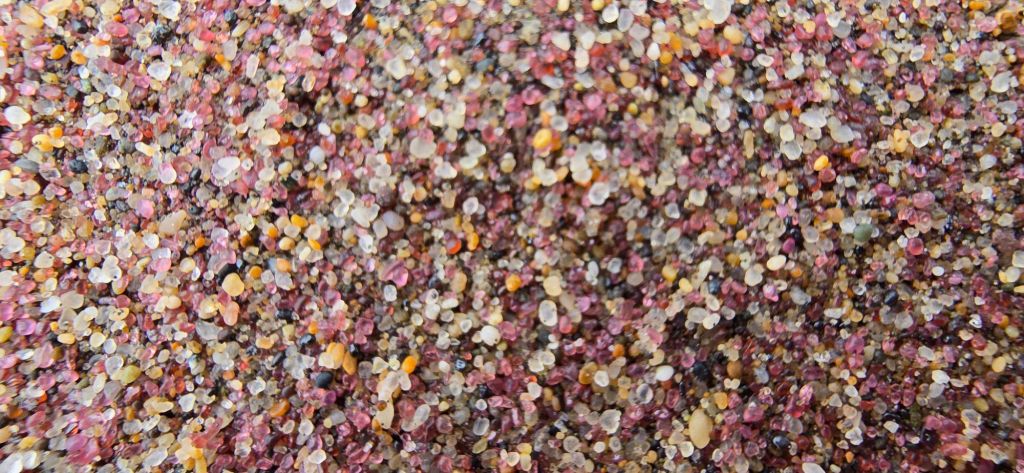
    The sand here is made of tiny gems and a quick macro shot of a tiny bit of sand made us feel like millionaires – can anyone spot any diamonds in the sample we’ve got?

    A tiny sample of sand from Sandwich Harbour

    The Living Dunes

    Whilst the dunes along the coast are part of the same range as those found in Sossusvlei, here they are known as the ‘Living Dunes’ as they are constantly changing.  Spikey Acacia trees grow in the sands and, as the wind blows the sand with the tides, the sands get trapped in the plants forming small mounds which eventually grow into dunes.

    Batis Birding tour

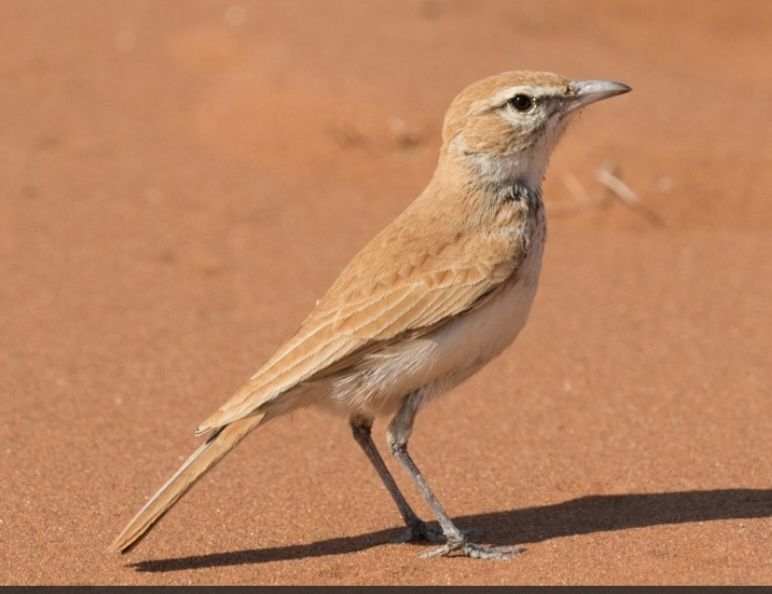
    Dune Lark

    The only bird that is endemic to Namibia is the Dune Lark, and Batis Birding Tours claim to know where to find them so we booked a day tour with them in the hope of finding this little bird, as well as finding other birds for Phil’s tick list. 

    We were  bit concerned when our guide warned us that on her recent trip, she had failed to find any Dune Larks. Thankfully, our trip was much more successful with 3 males displaying beautifully at our first port of call, leaving the rest of the day to discover more birding spots among the dunes and along the coast to build up Phil’s list.

    Back at our lodge, we spent our final night eating out at the Tug.  Located at the land end of the jetty, it is equally as popular as Jetty 1905, but it proved to be far superior in our opinion.  The staff were engaging from the minute we arrived, and remained attentive throughout our evening – and the food was fabulous too.

    Swakopmund

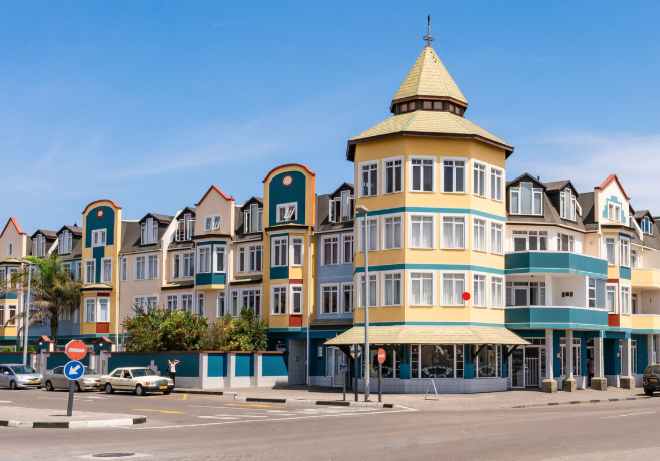
    Swakopmund is Namibia’s fourth largest city, and, despite its coastal location and cooler air, it seldom rains (Every 3-5 years is normal), but it does get very foggy in the mornings, providing plenty of water for plants and animals.

    Our packed itinerary left us little time to visit the town, but we managed a short drive-through to adnure this picturesque town with its German colonial buildings.

    The Stiltz

    We stayed at the Stiltz at the edge of town.  This charming accommodation comprises of several individual bungalows built on stilts overlooking a bird (and camel) rich lagoon, at the edge of the Atlantic Ocean.  A generous breakfast is served in a separate dining bungalow. 

    We stayed for 3 nights before heading back on the road to our next stop.

  • Namibia Days 1-2, Trains, Planes and automobiles

    Namibia Days 1-2, Trains, Planes and automobiles

    No matter how many times I fly (and I love flying), I still find airports very stressful environments, and Manchester Terminal 3 has now topped the list for being the worst embarking experience I’ve had.

    Our first flight was a domestic flight from Manchester to Heathrow, so check in only opened 2 hours before departure. Queues at check-in, followed by a long wait as our hold baggage was selected for additional security checks, then almost an hour going through security, left us with minutes to get to the gate and onto the plane.

    Then came our first delay. Apparently, the plane had not been cleared by an engineer for take-off, so we then waited an hour for an engineer to turn up. With only a 2 hour connection window (now reduced to 1 hour) at Heathrow, we ran from one end of Terminal 5 to the other, catching a transit train along the way, just in time to board our next flight. Following the recent cyber attack at Heathrow, the crew were having to do manual checks so boarding was slow and late. Once boarded, we found ourselves being delayed another hour (no reason given this time).

    The leg from Heathrow to Johannesburg was aboard the iconic Airbus A380. We’ve both wanted to fly on this plane for some time and our last trip that was due to be onboard an A380 was cancelled due to Covid, back in 2020. As they are gradually being phased out to make way for more fuel efficient transport, we thought our chance would never come.

    The A380 is a double-decker beast of a plane, and we booked seats in the upper deck, where twin seats make the journey more comfortable when travelling in a pair. Being on the upper deck also meant being further from the jets, so it was quieter onboard than usual. The flight itself was uneventful (although we did have a particularly grumpy member of cabin crew, who didn’t smile at all, and for whom everything was just a bit too much of an effort!) and the pilot managed to pull back some lost time, arriving in Johannesburg just 20 minutes later than scheduled. However, more delays occurred as the ground crew were unable to attach the sky bridges.

    The problem was eventually resolved and we made the long walk between Johannesburg airport’s 2 terminals to check in for our final flight of this part of the journey – an Airlink 2 hour flight to Windhoek.

    The plane was boarded promptly, left on time and the cabin crew were outstanding.  What really came as a pleasant surprise was the complimentary drinks and a pleasant meal.  Anyone who has flown short haul in recent years from the UK will appreciate that the demand for cheap flights has led to literally nothing apart from a seat being included in the price, so our expectation of a small snack and bottle of water were certainly exceeded.

    Namibia introduced visas for UK passport holders earlier this year, and we have been reading some horror stories of it taking 2-3 hours to pass immigration.  We’d prepared ourselves for a tiring queue, and once again were pleasantly and gratefully surprised when it took us only half an hour.  Border staff were friendly and efficient, so no complaints here.

    We were met by Geoffrey, who waited whilst we got cash and helped us sort out Sim cards for our phones, before transferring us to our first lodgings – the Olive Grove Guesthouse, in Windhoek.

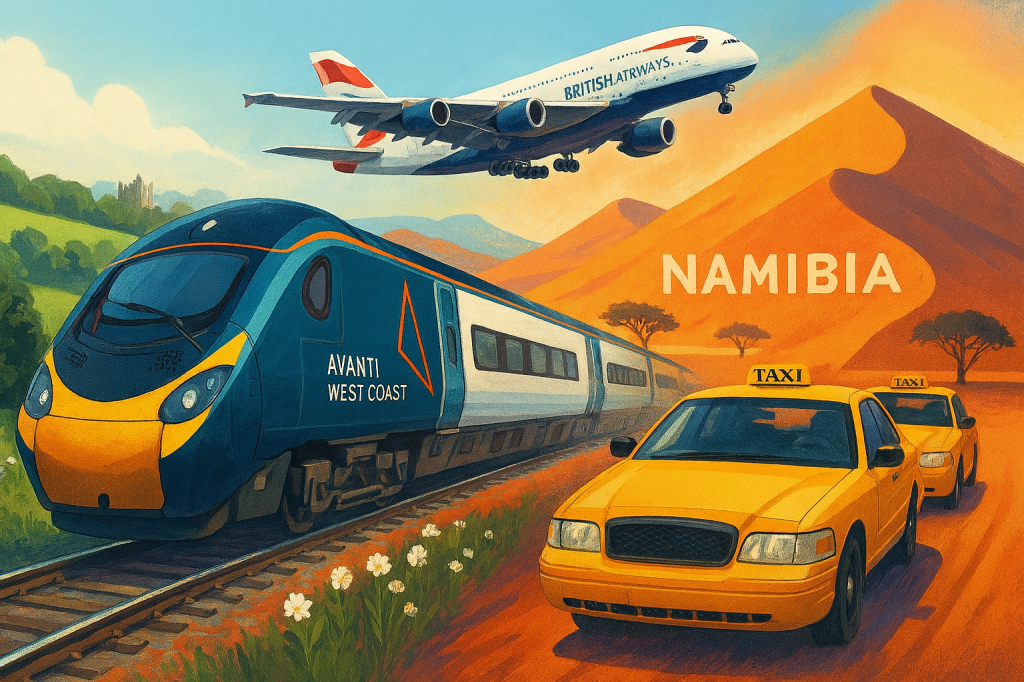
    The total journey involved 2 taxis, 2 trains, 3 planes, and various airport transits, and took 26 hours door to door.  8,300 steps and 5,820 miles.

    We settled in to our room, but no rest as we had a meet and greet session booked with our trip co-ordinator, Nikki, who spent an hour going through our itinerary in detail and offering some sound local advice.

    Quick showers and then out for a fabulous meal at Fresh ‘n’ Wild – Phil finally had the T-bone steak he’d promised himself as a retirement treat. A nice bottle of Shiraz washed the meal down well, and then we finally hit the pillows for an early night and some much needed sleep.